MIT 18.650 — Lecture 15
Introduction to Hypothesis Testing
§ Hypothesis Testing
Definition. A test is a function . Equivalently, a test is an estimator of a binary value.
The rejection region of a test is the set of all data for which .
A test statistic is a function that summarizes the data and is sufficient for computing a test .
In other words, a test is a process of reading in data and answering a question about the population based on that data. Given a parametric model , the question a test will answer must look like “Does or ?”, where .
Definition. The null hypothesis is the claim that , and the alternative is the claim that .
The distinction is that the null hypothesis is the “status quo” (e.g. “the drug does not outperform the placebo”).
§ Error Types
Of course, a test only reads in sample data, so the answer that it gives won't always be correct.
Definition. A Type I error occurs if is true but , and a Type II error occurs if is true but .
Type I is conventionally the more serious error: it is worse to wrongly declare “the drug outperforms the placebo”. Note that the probability of a Type I / Type II error depends on the true population parameter .
Definition. The size of a test is : the maximum possible probability of a Type I error. A test is said to have level if .
Definition. The power of a test is the function .
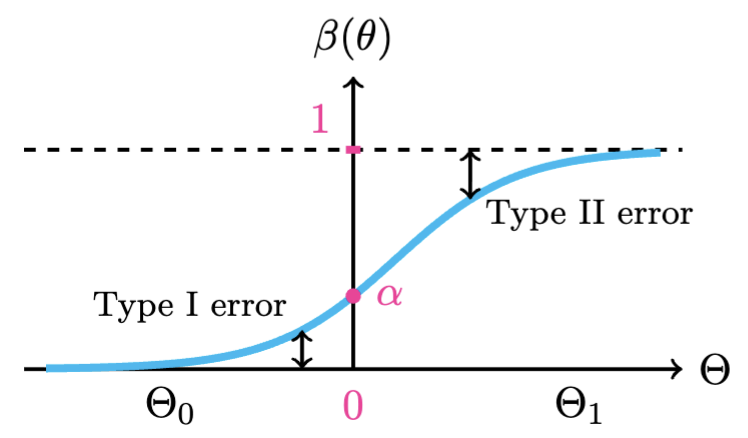
In the above, the size of is the -intercept . A perfect test would have be the Heaviside step function.