MIT 18.701 — Lecture 11
Point Groups, Lattices, Crystallographic Restriction, Group Actions
Last time, we classified all discrete subgroups of . Our goal for today is to answer the following question:
Question. What do all the discrete symmetry groups of a shape look like?
We'll set up today's discussion with the following theorem and definition.
Theorem. (Discrete Subgroups of ) Every discrete subgroup of is either of the form or , where and are linearly independent vectors in .
Proof: The proof is analysis-flavored, so we only provide a sketch here.
For any discrete subgroup , we may take to be the nonzero vector of least magnitude in , then take to be the vector of least magnitude in .
If there is still some , then look for the “remainder” when is quotiented out by to contradict the minimality of and .
Definition (Lattice). A subset of is a lattice if it is of the form or for linearly independent and .
§ Point Groups and Lattices
Definition (Point Group). Consider the map defined by . Intuitively, filters out the translations from the isometries in . Then for any discrete subgroup of :
The point group of is . In other words, describes the isometries in “up to translation”.
The lattice of is .
Why is a lattice? Because an isometry is in if and only if is a translation. So is a discrete group of translations of , so it's a lattice by the “Discrete Subgroups of ” theorem.
Example. The tilings of shown below are the square tiling, the pythagorean tiling, and the weaving tiling.
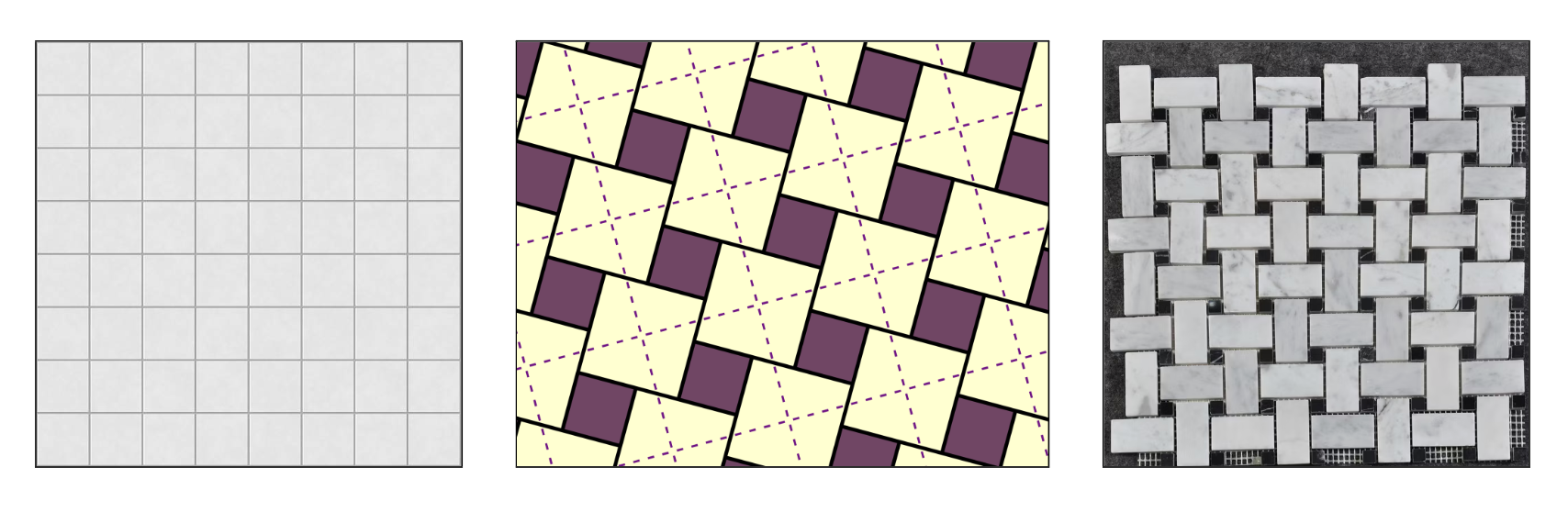
The point groups of their symmetry groups are the following:
The symmetry group of the square tiling has point group and lattice .
The symmetry group of the pythagorean tiling has point group and lattice shown by the dashed lines.
The symmetry group of the weaving tiling has point group . Some symmetries are glide reflections!
Remark. Importantly, the point group of a tiling is not the same as the group of isometries that fixes a single point. See the weaving tiling for an example of this.
§ Classifying Discrete Symmetry Groups: Mathematical Reasoning
Any discrete symmetry group is built out of its point group and its lattice . What can we say about the relationship between and ?
Theorem. (Point Groups are a Symmetry of the Lattice) Given a discrete subgroup , consider its corresponding point group and lattice .
Then for any and any , we have . In other words, .
Proof: Since and , we know the following about :
The isometry is in for some translation .
The isometry is in .
The key idea is to consider the conjugation of by , which is in .
Thus, is in , so is in , as desired.
What kind of point groups can preserve a lattice , then?
Theorem. (Crystallographic Restriction) Consider some point group , which must look like or for some . Then if is a nontrivial lattice preserved by , it must in fact be the case that .
Proof: The key idea is to consider the nonzero vector of minimal length in .
If , then contains some rotation by an angle less than . But then by geometry, contradicting the minimality of .
Similarly, if , then contains the rotation by angle . But then by geometry, contradicting the minimality of .
So the above implies , and we're done.
Thus, our answer to the big question for today is the following:
Answer. If is a discrete symmetry group with a nontrivial lattice, then
must look like or for some .
The original question asked for all the discrete symmetry groups of some shape . But our analysis so far has completely ignored the shape , so what remains is just shape-inspection for each candidate point group .
This shape-inspection, unfortunately, is mostly tedious. So we'll just skip to the results.
§ Classifying Discrete Symmetry Groups: The Results
We categorize our results based on the rank of our lattice.
Example (Rank 0 Lattices). If the lattice has rank zero, then , and every single point group or works (even if ). This is uninteresting.
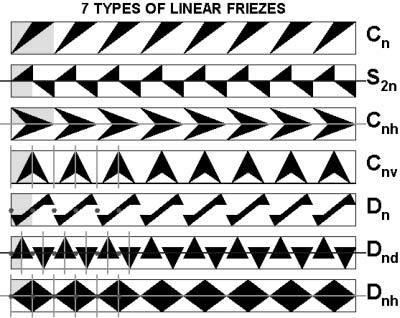
Example (Rank 1 Lattices: Frieze Groups). Consider the lattice . Then it turns out , achievable in different ways. These are called Frieze Groups.
Example (Rank 2 Lattices: Wallpaper Groups). For , there are different Wallpaper Groups.
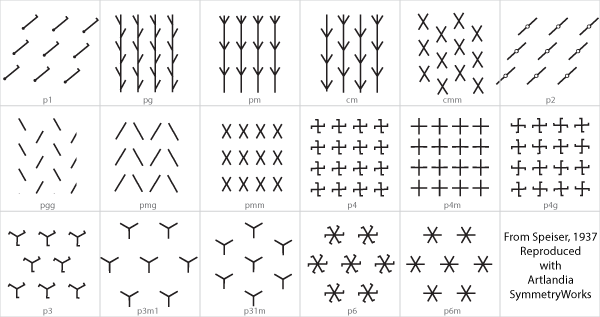
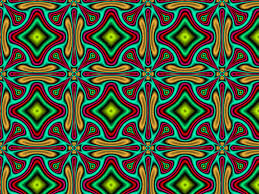
And these are all of the discrete symmetry groups of some shape . The end.
Remark. These are not meant to be memorized, unless you're a crystallographer or something.
§ Group Actions and Cayley's Theorem
Now for something completely different.
Definition (Action). Let be a group and be a set. Then an action of on is a map satisfying the following properties:
If is the identity of , then for all .
For any and any , both and correspond to the same element of .
For ease of writing, we will often denote the image of by .
Example. Some common examples of group actions are:
The permutation group acts on .
The group of linear transformations acts on .
Every group acts on the set of its own elements.
Importantly, the third point in the example above provides the intuition behind the following theorem.
Theorem. (Cayley's Theorem) Every group is isomorphic to a subgroup of , where .
Proof: Think of as a group action on the set of its own elements. Expressed more formally, there exists a map , where is the map for all .
Intuitively, is an injective homomorphism. Here's the formal mathematical jargon that justifies this intuition.
To show is a homomorphism, just write .
To show is injective, note that if , then , meaning .
Thus, is a subgroup of for which is an isomorphism, meaning and win.
Remark. This isomorphism from groups to subgroups of is very “space-inefficient”. For example, the encoding of as a group action on its own elements would yield a representation of as a subgroup of .