MIT 18.701 — Lecture 2
Group Examples, Subgroups, Isomorphisms, Homomorphisms
§ Group Theory Definitions (cont.)
Theorem. (Uniqueness of Identity) Any group has an identity . That identity , in fact, is unique.
Proof: If had two identities and , then , so in fact .
Definition (Cyclic Group). The cyclic group of order , denoted , is the set together with operation “addition modulo ”.
Definition (Cyclic Group v2). Equivalently, is the group together with operation “multiplication, given ”. This representation of better shows how is generated by a single element .
Definition (Direct Product). Given groups and , the group is the set together with the operation .
§ Group Examples by Order
We can now classify all groups of small order up to isomorphism.
Order 1. Only the trivial group.
Order 2. Only .
Order 3. Only .
Order 4. Only and .
These groups are non-isomorphic! One way to see this is to note that the claim “ for all ” is true for but false for .
Order 5. Only .
Order 6. Either or .
The groups and are the same group. One way to see this is to note that, just like , is also generated by a single element: .
The group is the lowest-order nonabelian group.
More generally, for primes , the only group of order is .
§ Subgroups
Definition (Subgroup). A group is a subgroup of another group if (i) , and (ii) the operation of is directly inherited from the operation of .
Example. The trivial group is a subgroup of any group.
Example. For any groups and , the group has subgroups and .
Example. The group has subgroups , , and (among many others).
Remark. If and are subgroups of , then is also a subgroup! However, is not usually a subgroup; closure is typically violated.
What if we consider subgroups in the context of matrix groups?
Example. The group has the following subgroups.
The group is a subgroup. But isn't: it doesn't have inverses!
The special linear group is a subgroup.
The special orthogonal group is a subgroup of .
§ Geometric Groups
Groups can capture geometric symmetries, turning geometric problems into algebraic problems!
Definition (Dihedral Groups). For any positive integer , the group consists of all symmetries of a regular -gon. Note that ; there are rotational symmetries and reflectional symmetries.
More complicatedly, one can consider the group of all symmetries of an icosahedron.
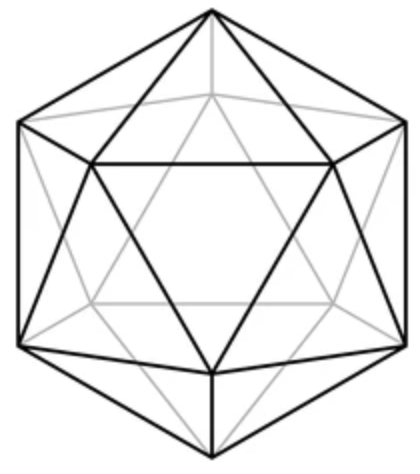
Tip: Learn how to freehand an icosahedron; it's not as hard as it looks!
Get excited to learn more about icosahedra!
§ Isomorphisms
We hand-waved the definition of isomorphism earlier. Let's fix that.
Definition (Isomorphism). Consider groups and . Then an isomorphism is a bijection such that for any , we have . In other words, you can pair the elements of and so that the products correspond under this pairing.
Definition (Isomorphic). Groups and are isomorphic if there exists an isomorphism . We use the notation to indicate that and are isomorphic.
Theorem. (Image of the Identity) Given an isomorphism , we have .
Proof: By definition of isomorphism, observe:
Example. The group of permutation matrices is isomorphic to .
Example. Recall the coincidence when ; therefore, . It turns out, in fact, that and are isomorphic! The isomorphism can be found by interpreting any symmetry of the equilateral triangle as a permutation of its vertices; the nontrivial rotations yield -cycles, and reflections yield -cycles.
§ Group Generation
Definition (Subgroup Generated by Subset). Let be a subset of a group . Then the subgroup generated by is the intersection of all subgroups of that contain .
Equivalently, we can think of the subgroup generated by as the set of all possible results of multiplying terms of the form or in some order. (Analogies: span, convex hull, fruit in a blender, …)
Example. If is not just a subset of , but more strongly a subgroup, then the subgroup generated by is just .
This lets us more formally define group generation.
Definition (Generation). A group is said to be generated by if the subgroup generated by is .
Theorem. (Generation by a Single Element) If is a group generated by a single element , then is either a cyclic group , or is .
Proof: By definition of subgroup generation, must contain every element in the set . If all of these elements are distinct, then is just .
Suppose some two elements are not distinct, then. This lets us choose distinct integers and such that , which implies . If we choose so that is as small as possible, then .
Unfortunately, the set of groups generated by two elements is much less tractable.
Theorem. (Subgroups of ) The only subgroups of are of the form for some integer .
Proof: One case is , corresponding to . So let's assume , which lets us take to be the smallest positive integer in .
Claim. For any , must be a multiple of .
Proof: Suppose the contrary. Divide by to yield as a quotient and as a remainder. It must follow that , where .
By closure of , however, observe that must also be in . But , contradicting the assumption that was the smallest positive integer in .
The above claim immediately implies , as desired.
§ Homomorphisms
What if isomorphisms didn't have to be bijective?
Definition (Homomorphism). A homomorphism between groups and is a function such that for any , we have .
Example. All isomorphisms are homomorphisms.
Example. Let and be literally any groups. Then defined by for all is a homomorphism: the trivial homomorphism.
Example. If is a subgroup of , then the inclusion (“do-nothing”) function is a homomorphism.
Example. There is a homomorphism (where ) defined by . The condition is equivalent to the identity .
Example. Take and . Then defined by is a homomorphism. This is a preview of a quotient homomorphism.
Example. Take and (where ). Then defined by is a homomorphism.
That last example lets us prove a very funny theorem.
Theorem. (Determinant of Permutation Matrices) Let be an permutation matrix. Then .
Proof: Let denote the aforementioned homomorphism . Then:
Recall and must be integers since and are both permutation matrices. Yet the product of these integers is , so the only possibility is that both and are , as desired.
Taking into account the fact that is isomorphic to the group of permutation matrices, we may define:
Definition (Permutation Sign). Consider the natural isomorphism . Then we say that the sign of a permutation is . (Note that the sign is always .)