MIT 18.701 — Lecture 4
The Correspondence Theorem, Quotient Groups, The Isomorphism Theorems, Conjugation in
§ Proof of the Correspondence Theorem
We'll start by giving a proof of the Correspondence Theorem.
Theorem. (Correspondence Theorem) Let be a surjective homomorphism, and let be its kernel. Consider the following collections of subgroups:
Then there is a bijection from to that sends subgroups to subgroups .
Proof: The proof is “largely self-proving”—the statement of the theorem itself is the deep part.
Step 1. For any and , we have and .
Proof: One needs to check the following:
The set contains the identity and is closed under multiplication and inverses.
The set contains the identity and is closed under multiplication and inverses.
The set contains .
The first two follow from being a homomorphism, and the third follows from the definition of .
Great! Now it remains to show is in fact a bijection. This comes in two steps.
Step 2. For any , we have .
Proof: The fact is clear—this is true for any function and any set , in fact! So it remains to show . The key tool for this step is the assumption that .
Equivalently, it remains to show that if , then .
The condition is equivalent to the claim that for some .
What does mean? It means for some , of course!
But both and are elements of , so must also be an element of , as desired.
And here's the final step.
Step 3. For any , we have .
Proof: Again, is clear, independent of the context of and . So it remains to show . The key tool for this step is the assumption that is surjective.
Equivalently, it remains to show that if , then .
Because is surjective, there exists some such that .
Well, then for this , we have . So , as desired.
Some “reading comprehension” questions:
Example. (Kernel) What goes wrong if subgroups in need not contain the kernel?
Solution: Consider a subgroup that does not contain . Then the subgroup of contains the identity of , so contains , but does not. So , which is bad.
Example. (Surjectivity) What goes wrong if need not be surjective?
Solution: Then the set could be whatever it wanted to be, so would not be surjective.
§ Quotient Groups
Recall that is a normal subgroup of (denoted ) if and only if for all .
Remark. Equivalently, if and only if for all (i.e. we only need to check one direction of inclusion). The reason is that subgroup conjugation is a bijection; and always have the same size.
Also recall that every kernel of a homomorphism is a normal subgroup. But does the other direction hold? Must every normal subgroup be the kernel of some homomorphism ?
Theorem. (Normal Subgroups Are Kernels) For every normal subgroup , there exists a homomorphism such that is the kernel of .
Proof: Here's the key observation.
Claim. The cosets of in are closed under multiplication, where multiplication of cosets and is defined by .
Proof: The product of and is equal to:
which itself is a coset, as desired!
Thus, we may take to be the group of all cosets of under the operation of coset multiplication! Then the homomorphism defined by is exactly what we need.
The group of cosets in the proof above has a special name.
Definition (Quotient Group). Given , the group of cosets of is the quotient group and is denoted .
Remark. Suppose we try to define the product of cosets and of as follows:
“Definition”. The product of and is .
This definition is flawed! There are many different possible we could choose for which “” holds. So depending on which we choose as a representative of , we might get a different product .
The crux of the above proof is the observation that implies that no matter which representatives we choose, the resulting product will be consistent!
Example. Take and to be . Then the quotient group is isomorphic to .
Remark. The claim that “cosets of are closed under multiplication” is false if is not a normal subgroup. Take and for a counterexample.
Example. Take the group and to be . Then the quotient group is isomorphic to .
§ The Isomorphism Theorems
There are many isomorphism theorems, whose names are largely inconsistent across sources.
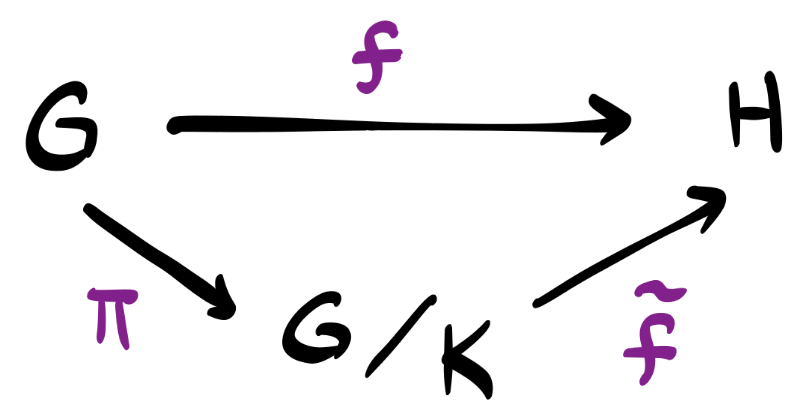
Theorem. (First Isomorphism Theorem) Let be a surjective homomorphism, and take . Then is isomorphic to under some isomorphism .
More strongly, if we denote , then there is a unique choice of for which .
Proof: The proof is similar to that of the Correspondence Theorem: it's not that deep. The constraint implies that for any , we must have:
So there is a unique way to define by sending to . Some things to check:
Check #1. Is well defined?
Proof: Yes! Suppose and refer to the same coset in ; then it suffices to show . Note that there exist such that , so we may write:
as desired. (The key simplifying step follows from .)
Check #2. Is an isomorphism?
Proof: Yes! The fact that preserves multiplication can be seen as follows:
The fact that is surjective follows from the surjectivity of .
And finally, the injectivity of follows from the fact that the equation has a unique solution:
These two checks suffice to show that our constructed works and is unique.
Now given any homomorphism , we may factor it as follows:
Note that may not be surjective, so consider the inclusion map .
The map is a surjective map, so we can apply the First Isomorphism Theorem on it! If , then this gives us the maps and .
Therefore, the map can be factored as .
See the “category theory” diagram below for a visualization of this factorization.
§ Conjugation and Normality in
Example. Consider a permutation and a cyclic permutation .
What does look like? Well, it sends to:
Therefore, the permutation can be written in cycle notation as . In other words, conjugating a permutation is equivalent to “relabeling” its entries.
In general, this means cannot be a normal subgroup of for . This is because can be generated by any -cycle of , so does not remain invariant under conjugation.