Conjugacy Classes, Centralizer, Center, Class Equation, Extensions, Simple Groups
There are two ways that a group G can act on itself:
Let G act on itself via group multiplication: g⋅x=gx for all actions g∈G acting on x∈G.
Let G act on itself via conjugation: g⋅x=gxg−1 for all actions g acting on x∈G.
We've explored the former already in the proof of Cayley's Theorem. But conjugation is also worth exploring!
In GLn(R), conjugation is the same as change of basis.
The identity StabG(gx)=gStabG(x)g−1 holds.
Conjugation measures commutativity: gx=yg for y=gxg−1.
§ Group Actions by Conjugation
Definition (Conjugacy Classes and Centralizers). Let G act on itself via conjugation. Then:
The conjugacy class of x∈G is the orbit of x; that is, the set C(x):={gxg−1:g∈G}.
The centralizer of x∈G is the stabilizer of x; that is, the set Z(x):={g∈G:gxg−1=x}={g∈G:gx=xg}.
The center of G is Z(G):=⋂x∈GZ(x)={g∈G∣C(g)={g}}={g∈G∣Z(g)=G}.
Some useful facts about conjugacy classes and centralizers:
Fact 1. Any group G can be partitioned into disjoint conjugacy classes (i.e. disjoint orbits).
Fact 2. The Orbit-Stabilizer Theorem says that for all x∈G, we have ∣G∣=∣C(x)∣⋅∣Z(x)∣.
Fact 3. The center Z(G) is a normal subgroup of G, since Z(G) commutes with everything.
Example. The conjugacy classes of S3 are {1}, {(12),(13),(23)}, and {(123),(132)}.
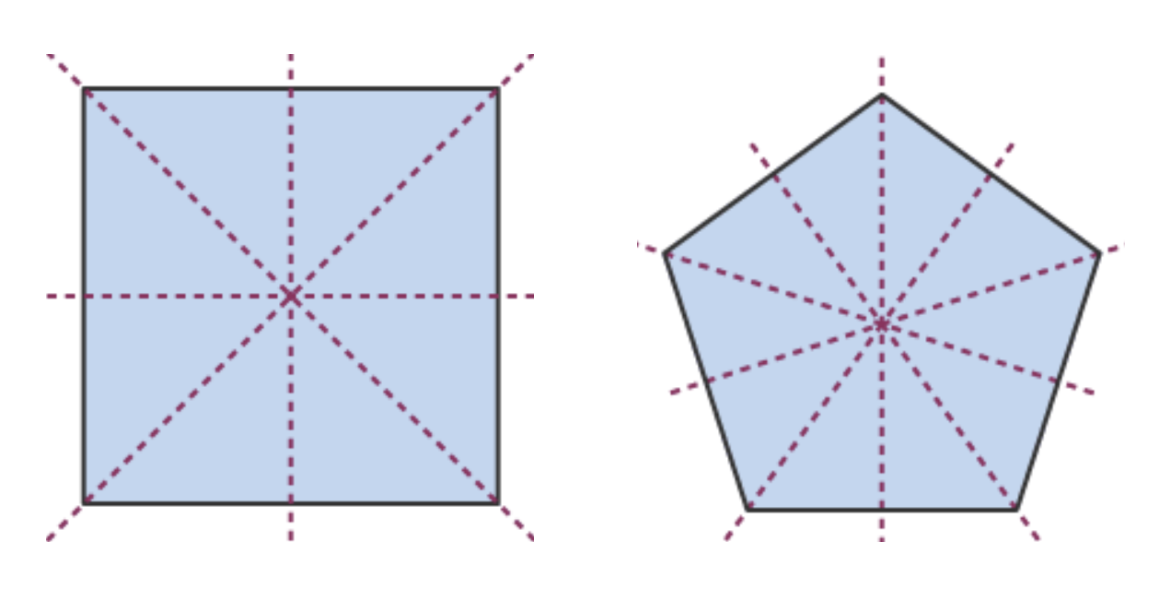
Example. The conjugacy classes of D5 are {1}, {r,r−1}, {r2,r−2}, and {all five reflections}.
Example. The conjugacy classes of D4 are {1}, {r,r−1}, {r2}, {diagonal reflections}, and {midline reflections}.
Remark. The conjugacy classes capture the geometric distinctions between D4 and D5. In particular, all reflections in D5 look the same, whereas reflections in D4 come in two different forms.
§ The Class Equation: Classifying Groups of p2 Order
Definition (Class Equation). If finite G has conjugacy classes C1,…,Ck, the class equation says ∣G∣=∑i=1k∣Ci∣.
Example. The class equations of D4 and D5 read 8=1+2+1+2+2 and 10=1+2+2+5, respectively.
Definition (p-group). For primes p, a group G is a p-group if ∣G∣=pk for some k∈{0,1,2,…}.
Example. All of the following are p-groups:
{1} or Cp or Cp×Cp or Cp2 or {[100x10yz1]:x,y,z∈Fp}
The big goal of today's lecture will be to use the Class Equation to prove the following:
Theorem. If group G has order p2 for some prime p, then either G≅Cp×Cp or G≅Cp2.
The proof of this theorem will come in three steps.
Theorem. (Claim #1: Nontrivial Center) Every nontrivial group of order pk has a nontrivial center.
Proof: Suppose the center has size n. Then the Class Equation reads:
n times1+⋯+1+∣Cn+1∣+⋯+∣Cℓ∣=pk.
The key observation is that, for all Ci∈{Cn+1,…,Cℓ}, we have p∣∣Ci∣ by Orbit-Stabilizer. So the above equation modulo p reads n≡0(modp). But n=0 since id∈Z(G), so n≥p, done. ■
Note that the above claim holds for any nontrivial group G of prime-power order! But when ∣G∣=p2, specifically…
Theorem. (Claim #2: Abelian) Since ∣G∣=p2, it must be that G is abelian.
Proof: Equivalently, we wish to show ∣Z(G)∣=p2. Since Z(G) is a subgroup of G, by Lagrange's Theorem, ∣Z(G)∣ divides p2. Claim #1 then says either ∣Z(G)∣=p or ∣Z(G)∣=p2. Argue by contradiction: suppose ∣Z(G)∣=p.
Recall that Z(G) is normal. Thus, if ∣Z(G)∣=p, then ∣G/Z(G)∣=p, meaning G/Z(G)≅Cp. In particular, if we pick any x∈Z(G), then G must be generated by x and Z(G). Therefore,
G={xkz∣k∈{0,1,…,p−1} and z∈Z(G)}.
Since Z(G) commutes with x, the above means G is abelian, and in particular ∣Z(G)∣=p2 (contradiction). ■
We're now ready to finish the proof.
Theorem. (Claim #3: Classification) If ∣G∣=p2 and G is abelian, then G≅Cp×Cp or G≅Cp2.
Proof: If G has an element of order p2, then G≅Cp2. The only other case is that every x∈G has order dividing p.
In this latter case, we claim G may be viewed as an Fp vector space. To confirm this is legal, we must check:
Does G have abelian vector addition? Well, yes—this follows from Claim #2.
Does G have well-defined scalar multiplication? Well, yes—just define λx=x+⋯+xλ times.
(To check this is well-defined, we require that px=0 for all x∈G. But this is true because x has order dividing p.)
Recall that all Fp vector spaces are isomorphic to Fpk (i.e. pick a basis). Thus, G≅Fp2, so G≅Cp×Cp. ■
§ Definitions: Group Extensions
Definition (Extensions). For group G and normal subgroup N⊴G, say G is an extension of G/N by N.
Suppose G is an extension of A by B. Some warnings:
The extension G need not be unique. For example, C6 and S3 are both extensions of C2 by C3.
G need not be an extension of B by A. For example, S3 is an extension of C2 by C3, but not of C3 by C2.
A need not be a subgroup of G. For example, Z is an extension of C2 by Z.
Definition (Split Extension). Say G is a split extension of G/N by N, with π:G→G/N, if there exists a subgroup H⊆G such that π∣H:H→G/N is an isomorphism.
In other words, G is a split extension of A by B if the quotient G/B≅A is visibly embedded within G.
Example. For any groups G and H, G×H is a split extension of G by H.
Example. For any n, the isometry group Mn is a split extension of On(R) by Rn. In other words, the quotient On(R)≅Mn/Rn is visibly embedded within Mn.
§ Definitions: We're a Finite Simple Group…
Definition (Simple Groups). A nontrivial group G is simple if it has no normal subgroups besides {1} and G.
Example. For any prime p, the group Cp is simple. For any n≥5, the group An is simple—this is nonobvious!
The classification of all finite simple groups looks like:
Groups of prime order Cp.
Groups of the form An for some n≥5.
Groups of Lie Type, constructed from matrix multiplication.