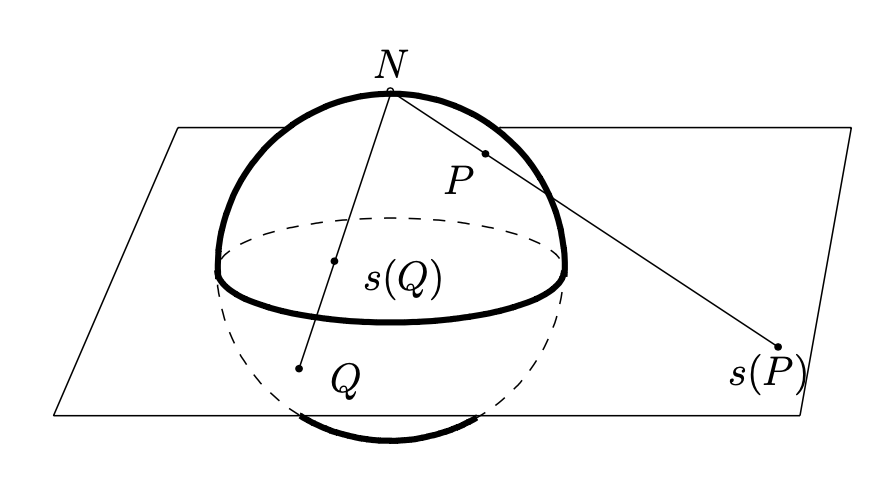
Definition (n-Sphere). The n-dimensional surface of a sphere is Sn:={x∈Rn+1:∣x∣=1}.
Definition (n-Ball). The n-dimensional interior of a sphere is Bn:={x∈Rn:∣x∣≤1}.
Example. The stereographic projection is a continuous, bijective map with continuous inverse (homeomorphism) from Sn∖{N} to Rn.
Analogously, reversing the stereographic projection yields a sense in which Rn∪{∞}≅Sn.
Example. Volumes behave very weirdly in higher dimensions!
The ratio of the volumes of 0.99⋅B2 and B2 is 0.9801.
The ratio of the volumes of 0.99⋅B1000 and B1000 is roughly 4×10⁻⁵.
For large n, almost all of the volume of Bn comes from its outermost “shell”.
§ The Special Unitary Group SU2
Definition (Special Unitary Group). The special unitary group in Cn is:
SUn:=SLn(C)∩Un={A∈Cn×n∣AA†=In,detA=1}.
Theorem. (SU2≅S3) Matrices in SU2 naturally map bijectively to points on S3.
Proof: If A=[αγβδ] is in SU2, then:
AA†=[∣α∣2+∣β∣2αγ+βδαγ+βδ∣γ∣2+∣δ∣2]=[1001] and detA=1⟺δ=α and γ=−β and ∣α∣2+∣β∣2=1
Thus, every A in SU2 is parametrized by (α,β)∈C2 with ∣α∣2+∣β∣2=1.
If α=w+ix and β=y+iz, we see SU2 is in fact {(w,x,y,z)∈R4∣w2+x2+y2+z2=1}, which is S3. ■
Remark. Unfortunately, this is the nicest things will get.
There is no nice spherical geometry to SUn for n>2.
The only spheres that could possibly be topological groups are S0, S1, and S3.
§ The Quaternions H
We can rephrase our parametrization of SU2 as follows.
Theorem. (SU2 is a Span) Every matrix M in SU2 is a linear combination in C2×2 of the form:
M=w[1001]+x[i00−i]+y[0−110]+z[0ii0], given that w2+x2+y2+z2=1.
And here's the definition of the quaternions.
Definition (Quaternion). The quaternions are the set H=R+Ri+Rj+Rk, constrained on:
i2=j2=k2=−1 and ij=k=−ji and jk=i=−kj and ki=j=−ik
(Those last three equations are analogous to cross products in R3.)
Definition (Length). The length of any α=w+xi+yj+zk∈H is ∣α∣:=w2+x2+y2+z2.
Theorem. (SU2 are Unit Length H) Matrices in SU2 map bijectively with the elements w+xi+yj+zk∈H with coefficients satisfying w2+x2+y2+z2=1.
Proof: The bijection f:{h∈H:∣h∣=1}→SU2 is via f:(i,j,k)↦([i00−i],[0−110],[0ii0]), which works. ■
Remark. To really spell things out…
{r∈R:∣r∣=1}↔S0 and {z∈C:∣z∣=1}↔S1 and {h∈H:∣h∣=1}↔S3
Definition (Conjugation). Given an α=w+xi+yj+zk∈H, its conjugate is α:=w−xi−yj−zk.
Theorem. (Conjugation Properties) For any α,β∈H, we have:
α+β=α+β and α⋅β=β⋅α and α⋅α=∣α∣2 and ∣α⋅β∣=∣α∣⋅∣β∣
Proof: Just plain computation. It's worth seeing how the fourth identity follows from the second and third! ■
§ Sidenote: Linear Algebra Over H
Definition (Skew Field). A skew field (also called a division algebra, or a corps non commutatif in French) is a field with not-necessarily-commutative multiplication.
Theorem. (Skew Fields Over R) The only skew fields with finite dimension as R-vector spaces are R, C, and H.
It also turns out that you can do almost all of linear algebra over skew fields!
Definition (Vector Space Over Skew Fields). Let F be a skew field. Then V is a vector space over F if it has commutative addition, right scalar multiplication, and left matrix multiplication.
Under this definition, things like GLn(H) still make sense! Indeed, GLn(H) is just a subgroup of GL4n(R).
Theorem. (Classification of Compact Connected Lie Groups) Suppose G is a connected, bounded, and closed (under limits) subgroup of GLn(R). Then it must be that G≅(∏iHi)/K, where:
Each Hi is either S1, Spink (i.e. a double-cover of SOk), SUk, Uk(H), or one of five exceptional groups.
The group K is a finite subgroup of the center of ∏iHi.
§ Sidenote: A Number Theoretic Application
Recall that the identity ∣u⋅v∣2=∣u∣2⋅∣v∣2 for u,v∈C, upon taking u=a+bi and v=c+di, yields:
(a2+b2)⋅(c2+d2)=(ac−bd)2+(ad+bc)2.
This gives you the following theorem:
Theorem. (Sums of Two Squares) Let S⊆Z+ be the set of all positive integers that are the sums of two squares. Then S is multiplicatively closed.
The quaternionic version of this analogously gives another theorem:
Theorem. (Sums of Four Squares) Let S⊆Z+ be the set of all positive integers that are the sums of four squares. Then S is multiplicatively closed.
(In fact, in the above theorem, it turns out that S=Z+.)
However, if we replace “four squares” with “three squares”, it turns out this theorem is NOT true! For example, 3=12+12+12 and 5=22+12+02, but 15 is not the sum of three squares.