Classifying Hermitian Forms, Sylvester's Law of Inertia
§ Classifying Hermitian Forms
Today's lecture will look a lot like Lecture 8 on the Jordan Normal Form. In Lecture 8, we proved:
Theorem. (Jordan Normal Form) Let T:V→V be a linear transformation with n eigenvalues {λ1,…,λn}. Then with an appropriate choice of basis, the matrix corresponding to T can be made to look like:
In other words, we showed that all linear transformations—with an appropriate choice of basis—can be made to look like a matrix of Jordan Blocks. Today is dedicated to proving the following analogous theorem:
Theorem. (Hermitian Form Classification) Let ⟨∙,∙⟩:V×V→C be a Hermitian form over a C-vector space V, with signature (n1,n0,n−1). Then with an appropriate choice of basis, ⟨∙,∙⟩ can be made to look like:
⟨x,y⟩=x†My where M=In1000−In−10000n0 (where 0n0 is the n0×n0 zero matrix.)
In other words, we'll show that all Hermitian forms—with an appropriate choice of basis—can be made to look like a diagonal matrix with only 1s, −1s, and 0s. (We'll define “signature” later.)
Remark. Here's another way to see the analogy. Lecture 8 answered the following question:
Take the group action of GLn(F) on Fn×n, where A∈GLn(F) acts on M∈Fn×n via M↦A−1MA. What are the orbits of this group action?
Today's lecture will answer the following alternative question:
Take the group action of GLn(C) on Hermn(C), where A∈GLn(C) acts on M∈Hermn(C) via M↦A†MA. What are the orbits of this group action?
Notably, because R⊆C, our classification of Hermitian forms over C also works equally well toward classifying symmetric forms over R: all symmetric forms over Rn under some basis look diagonal with entries −1, 1, and 0.
§ Orthogonality and Nondegenerate Subspaces
Our proof relies on a couple definitions.
Definition (Orthogonal Subspace). Let V be a finite-dimensional C-vector space with Hermitian form ⟨∙,∙⟩. Given a subspace W⊆V, its orthogonal subspace is W⊥:={v∈V∣⟨w,v⟩=0∀w∈W}.
Example. Depending on our choice of Hermitian form, orthogonality can be very counter-intuitive!
Take V=C2 with Hermitian form ⟨x,y⟩=x†[100−1]y. Then (11) is orthogonal to itself!
Take V=C2 with Hermitian form ⟨x,y⟩=x†[1000]y. Then V⊥ is nontrivial: it's {(0λ)∣λ∈C}.
Definition (Nondegenerate). A Hermitian form ⟨x,y⟩ over a C-vector space V is nondegenerate if V⊥={0}. More generally, a subspace W⊆V is nondegenerate if W∩W⊥={0}.
Example. As we saw in the previous example, V=C2 with ⟨x,y⟩=x†[1000]y is degenerate.
Example. Also as in the previous example, consider V=C2 with Hermitian form ⟨x,y⟩=x†[100−1]y.
This Hermitian form is nondegenerate.
The subspace {(λ0)∣λ∈C} is also nondegenerate.
The subspace W={(λλ)∣λ∈C} is degenerate! In particular, W⊥=W.
Theorem. (Nondegenerate ⟺ Invertible) Let V be a C-vector space with a chosen basis and a Hermitian form ⟨x,y⟩=x†Ay. Then ⟨∙,∙⟩ is nondegenerate if and only if A is invertible.
Proof: Suppose ⟨∙,∙⟩ is degenerate, so there is a nonzero y∈V such that ⟨x,y⟩=0 for all x∈V. Equivalently, for all x∈V, we have x†Ay=0. This is possible if and only if Ay=0, that is, A is not invertible. ■
The previous theorem will be useful for our proof of Hermitian Classification. This next one is just a fun fact.
Theorem. (Nondegenerate ⟹ Injectivity) Let V be a C-vector space with nondegenerate Hermitian form. Suppose v,v′∈V satisfy ⟨v,w⟩=⟨v′,w⟩ for all w∈V. Then v=v′.
Proof: Observe ⟨v,w⟩=⟨v′,w⟩ implies ⟨v−v′,w⟩=0 for all w∈V, which means v−v′∈V⊥. But the Hermitian form was nondegenerate, so V⊥={0}, meaning v−v′=0. ■
§ Proving Hermitian Classification
Definitions aside, here's the driving theorem of our proof of Hermitian form classification.
Theorem. (Orthogonal Decomposition) Let W be a nondegenerate subspace of a nondegenerate C-vector space V. Then the decomposition V=W⊕W⊥ holds. Furthermore, W⊥ is also nondegenerate.
Assuming this theorem to be true, we propose the following proof of Hermitian form classification:
Proof: We may assume V is nondegenerate, as the degenerate subspace V⊥ may be “taken out”.
Argue by induction on dimV, where the base case of dimV=1 is trivial. Now pick a nondegenerate subspace W⊆V and set the basis of V to the union of bases of W and W⊥.
Because the “Orthogonal Decomposition” theorem holds, the M in ⟨x,y⟩=x†My must now look like:
M=[M100M2] where ⟨x,y⟩=x†M1y in W, and ⟨x,y⟩=x†M2y in W⊥.
The zero-entries are guaranteed because ⟨e1,e2⟩=0 for any basis vectors e1∈W and e2∈W⊥.
Apply the inductive hypothesis on W and W⊥ so M1 and M2 are diagonal with only −1s, 0s, and 1s. Rearrange the diagonal entries to finish. ■
Pretty simple, right? It remains to justify the statements written in teal. Starting with the first…
Theorem. (Justification #1: Degeneracy) If the Hermitian form classification holds for all nondegenerate V, then it also holds for all degenerate V.
Proof: Set the basis of V by first choosing a basis for V⊥ and then extending it to all of V. This way, V=V⊥⊕V∗ for some nondegenerate vector space V∗. Then the M in ⟨x,y⟩=x†My looks like:
M=[000M∗], where 0 indicates a submatrix of zeroes.
Then since V∗ is nondegenerate, M∗ may be written in the desired form, at which point M is too. ■
Now to justify the base case…
Theorem. (Justification #2: The Base Case) Let ⟨∙,∙⟩ be a Hermitian form over a one-dimensional C-vector space. Under an appropriate choice of basis, ⟨∙,∙⟩ can be made to look like either [1], [−1], or [0].
Proof: In the one-dimensional case, any change of basis M↦A†MA looks like the following:
Given M=[m] and A=[λ],we have A†MA=[∣λ∣2m].
And ∣λ∣2 can be any positive real number, so ∣λ∣2m can be made to equal either 1, −1, or 0 as needed. ■
For Justification #3, we'll use the fact that V is nondegenerate… (Do you see where?)
Theorem. (Justification #3: Picking a Nondegenerate Subspace) Let V be a nondegenerate C-vector space with Hermitian form ⟨∙,∙⟩. Then V has a 1-dimensional nondegenerate subspace W.
Proof: We begin with the following lemma.
Lemma. There exists some v∈V with ⟨v,v⟩=0.
Proof: Pick some x,y∈V such that ⟨x,y⟩=0. We can also pick some λ∈C so that ⟨x,λy⟩=λ⟨x,y⟩ is real and nonzero. Because of this real-ness, ⟨x,λy⟩=⟨λy,x⟩, so the Polarization Identity holds:
⟨x,λy⟩=2⟨x+λy,x+λy⟩−⟨x,x⟩−⟨λy,λy⟩.
Since ⟨x,λy⟩=0, at least one of {x+λy,x,λy} must be a valid choice for v∈V with ⟨v,v⟩=0. □
Take v as in the above lemma. Then for any nonzero a,b∈Cv, we have ⟨a,b⟩=0, so Cv is nondegenerate. ■
And finally, the most crucial step: justifying the “Orthogonal Decomposition” theorem…
Theorem. (Justification #4: Orthogonal Decomposition) Let W be a nondegenerate subspace of a nondegenerate C-vector space V. Then the decomposition V=W⊕W⊥ holds, and W⊥ is nondegenerate.
Proof: Suppose n=dimV and k=dimW. We claim the following:
Claim. We always have dimW⊥≥n−k (regardless of whether W or V are degenerate or not!).
Proof: The only constraints on elements w⊥∈W⊥ are that ⟨w⊥,w⟩=0 for all w∈W. It's good enough to ensure this constraint holds for exactly k choices of w, where these k choices together span W.
So W⊥ is the set of vectors w⊥∈V satisfying k linear constraints of the form ⟨w⊥,w⟩=0, which must have dimension at least n−k. □
However, W∩W⊥={0} because W is nondegenerate. Thus, V=W⊕W⊥ follows for dimension reasons.
It remains to show W⊥ is nondegenerate; this is where the nondegeneracy of V becomes necessary. Suppose, for the sake of contradiction, that some nonzero v∈W⊥ were also in (W⊥)⊥. Then:
Since v∈(W⊥)⊥, it follows that v is orthogonal to all of W⊥.
Since v∈W⊥, it follows that v is orthogonal to all of W.
But V=W⊕W⊥, so the above implies v is orthogonal to all of V, contradicting the nondegeneracy of V. ■
And that's the proof!
§ Signatures and Sylvester's Law of Inertia
Okay, one more thing… does every Hermitian form have a unique representation in this classification?
Definition (Signature). Take a Hermitian matrix M in the form described by this classification. Its signature is the ordered triple (n1,n0,n−1) with the number of +1s, 0s, and −1s, respectively, along the diagonal of M.
Theorem. (Sylvester's Law of Inertia) Every Hermitian form has a unique signature, irrespective of basis.
Proof: Suppose a Hermitian form has two signatures (n1,n0,n−1) and (n1′,n0′,n−1′). Then:
The signature (n1,n0,n−1) yields a decomposition V=W1⊕W0⊕W−1.
The signature (n1′,n0′,n−1′) yields a decomposition V=W1′⊕W0′⊕W−1′.
Suppose, without loss of generality, that n1′>n1.
Then W1′∩(W0⊕W−1)={0} for size reasons. But this means there is some nonzero v∈V such that:
We have v∈W1′, so v is a nonzero vector with positive norm.
We have v∈W0⊕W−1, so v is a nonzero vector with nonpositive norm.
And obviously, that's a contradiction. ■
§ Foreshadowing: Signatures are Critical Points…
To conclude, we provide some handwavy foreshadowing on some applications of today's lecture.
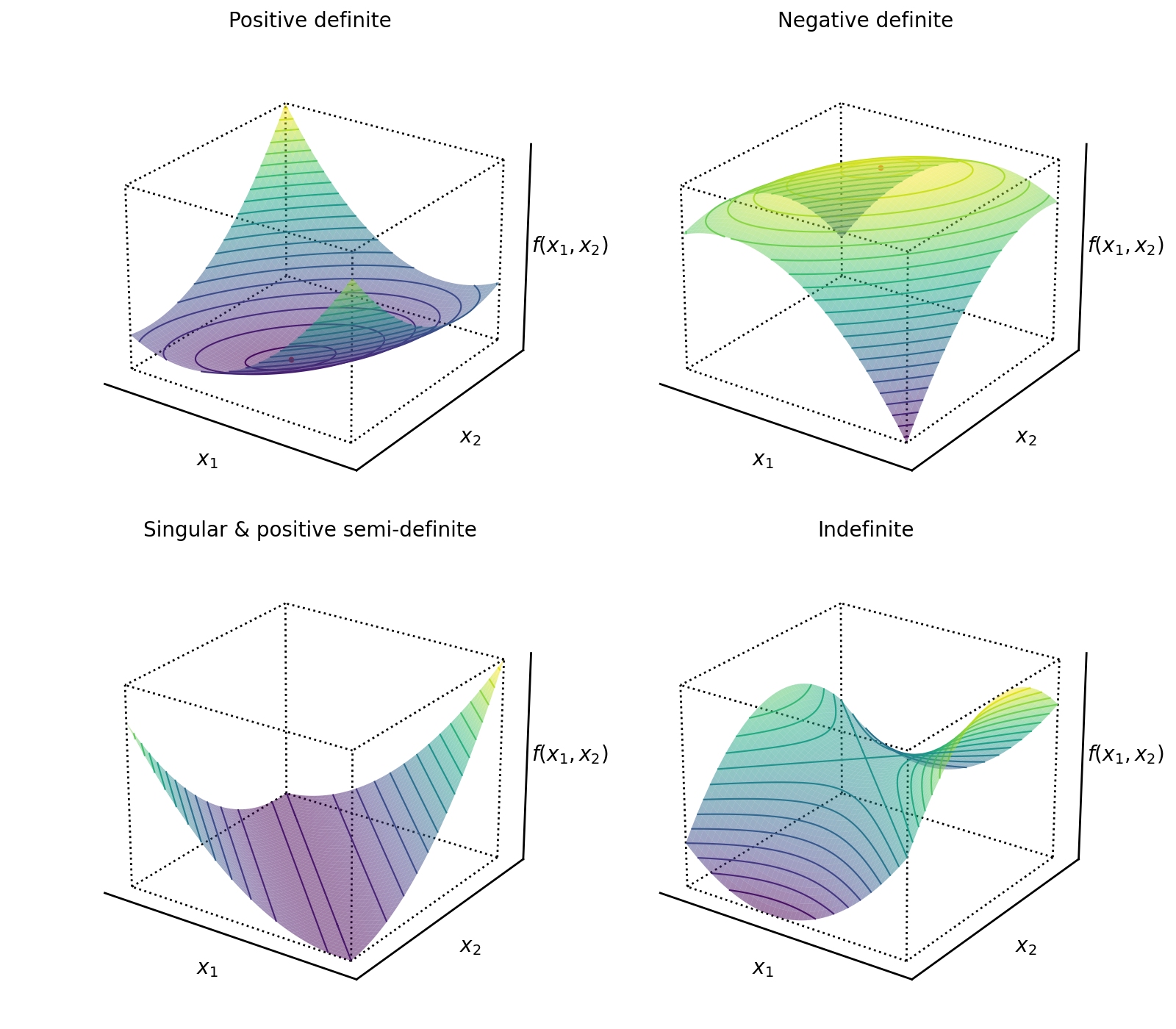
Recall from last lecture (Section 16.3) that the Hessian is a matrix that encodes the “quadratic”-ness of a function f:Rn→R. It turns out the signature of the Hessian describes the behavior of the critical point!