The only group we've shown to be simple is Cp for primes p. Let's find a more complicated simple group.
§ Icosahedron Symmetries are Simple
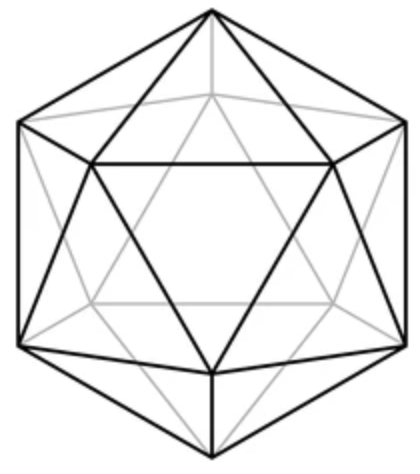
Consider G to be the rotational symmetry group of a regular icosahedron.
We know from Lecture 12 that G⊆SO3(R) has 60 group elements. These elements are:
group elements of G=⎩⎨⎧identity rotationsrotations around an axis through a facerotations around an axis through an edgerotations around an axis through a vertex(+1)(+20)(+15)(+24)
What do the conjugacy classes of G look like? Well, conjugation is just a change of coordinates, so:
conjugacy classes of G=⎩⎨⎧identity rotationsrotations around an axis through a facerotations around an axis through an edgerotations by ±52π about an axis through a vertexrotations by ±54π about an axis through a vertex(+1)(+20)(+15)(+12)(+12)
The above will let us show G is simple!
Theorem. (Simplicity of Icosahedra) The group G is simple.
Proof: Suppose H⊴G is a normal subgroup. Recall this means gHg−1=H for all g∈G. Equivalently, H must be the union of conjugacy classes of G.
But by inspection, the union of conjugacy classes of G (including {1}) cannot have a number of elements that is a divisor of 60 (other than 1 or 60). So H cannot exist. ■
The crux of the above argument, to reiterate, was the following useful observation:
Theorem. (Normals are Conjugacy Classes) If H⊴G, then H is the union of conjugacy classes of G, including the conjugacy class consisting of just the identity.
Remark. It turns out that G≅A5. One way to see this is to note:
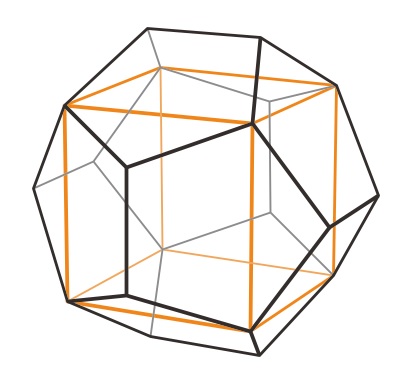
The rotations G of a regular icosahedron are isomorphic to the rotations G′ of a regular dodecahedron.
There are 5 cubes inscribed in a regular dodecahedron.
Thus, G is isomorphic to permutations of those 5 cubes, and it turns out that these permutations must be even.
Note that point #2 also gives a good strategy for drawing a dodecahedron…
§ Composition Series
Definition (Composition Series). Let G be a group. Then a composition series of G is a chain:
G=G0⊇G1⊇G2⊇⋯⊇Gr={1}
satisfying the property that for all i, we have Gi⊴Gi−1 and Gi−1/Gi is simple.
Remark. Confusingly, smaller groups get larger indices. Also, simple groups are not trivial, so Gi−1=Gi.
Example. The group C6=⟨x⟩ has two composition series:
⟨x⟩⊇⟨x3⟩⊇{1} and ⟨x⟩⊇⟨x2⟩⊇{1}
Meanwhile, the infinite group (Z,+) has no composition series: nontrivial subgroups of Z are isomorphic to Z.
Theorem. (Existence of Composition Series) Every finite group G has a composition series.
Proof: It's good enough to build the following chisel.
Chisel. Given groups G and H with H⊴G and G/H not simple,
the chisel constructs a group T such that H⊴T⊴G, with H=T=G.
To build a composition series given a chisel, we can just start with {1}⊴G and use the chisel repeatedly.
How does the chisel work? Well, since G/H is not simple, there must exist some normal subgroup N⊴G/H besides {1} and G/H. So the chisel decides to choose T:=π−1(N), where π:G→G/H is the quotient map.
We now check the chisel's work by showing this choice of T is valid:
We know H is a subgroup of T and T is a subgroup of G both by the Correspondence Theorem.
The fact H⊴T follows from directly combining H⊴G and T⊆G together. Indeed,
“For all g∈G, we have gHg−1=H.” implies “For all t∈T, we have tHt−1=H.”
The fact T⊴G follows from the property π(T)=N⊴G/H. Indeed, for any g∈G,
π(gTg−1)=π(g)π(T)π(g−1)=π(g)Nπ(g)−1=N since N⊴G/H.
Thus, gTg−1⊆π−1(N)=T for all g. And gTg−1⊆T for all g∈G is good enough to show T⊴G.
So the chisel works correctly, and we're done. ■
§ The Jordan-Holder Theorem
It turns out composition series are unique, up to order of “prime factors”!
Theorem. (Jordan-Holder) Suppose G has two composition series:
G=A0⊇A1⊇⋯⊇Ar={1} and G=B0⊇B1⊇⋯⊇Bs={1}
Then the simple quotients {Ai/Ai+1:i=0,1,…,r−1} map bijectively with {Bi/Bi+1:i=0,1,…,s−1}.
Example. The two composition series of C6 have the same sets of simple quotients: {C3,C2} and {C2,C3}.
⟨x⟩⊇⟨x3⟩⊇{1} has quotients ⟨x⟩/⟨x3⟩≅C3 and ⟨x3⟩/{1}≅C2.⟨x⟩⊇⟨x2⟩⊇{1} has quotients ⟨x⟩/⟨x2⟩≅C2 and ⟨x2⟩/{1}≅C3.
We'll spend the rest of lecture proving the Jordan-Holder Theorem. But first, some precautions:
Two non-isomorphic groups can have the same sets of simple quotients. For example,
S3⊇A3⊇{1} has quotients S3/A3≅C2 and A3/{1}≅C3.C6⊇C3⊇{1} has quotients C6/C3≅C2 and C3/{1}≅C3.
But unfortunately, C6≅S3.
The condition Gi⊴Gi−1 does not imply, transitively, that Gm⊴Gn for all m≥n. For example, taking
we see that G2⊴G1 and G3⊴G2 both hold, but G3⊴G1 does not hold.
§ The Second Isomorphism Theorem
We'll need two lemmas to prove the Jordan-Holder Theorem. This one's the first.
Theorem. (The Second Isomorphism Theorem) Suppose H,K⊆G are subgroups with K⊴G. Then:
The set HK={hk∣h∈H,k∈K} is a subgroup of G.
The isomorphism HK/K≅H/(H∩K) holds. (Here, we are also implicitly claiming that (H∩K)⊴H.)
Proof: To prove the first point, we simply check that 1∈HK (obviously), that (hk)−1=h−1(hk−1h−1)∈HK, and:
hkh′k′=∈H(hh′)∈K(h′−1kh′)∈K(k′)∈HK.
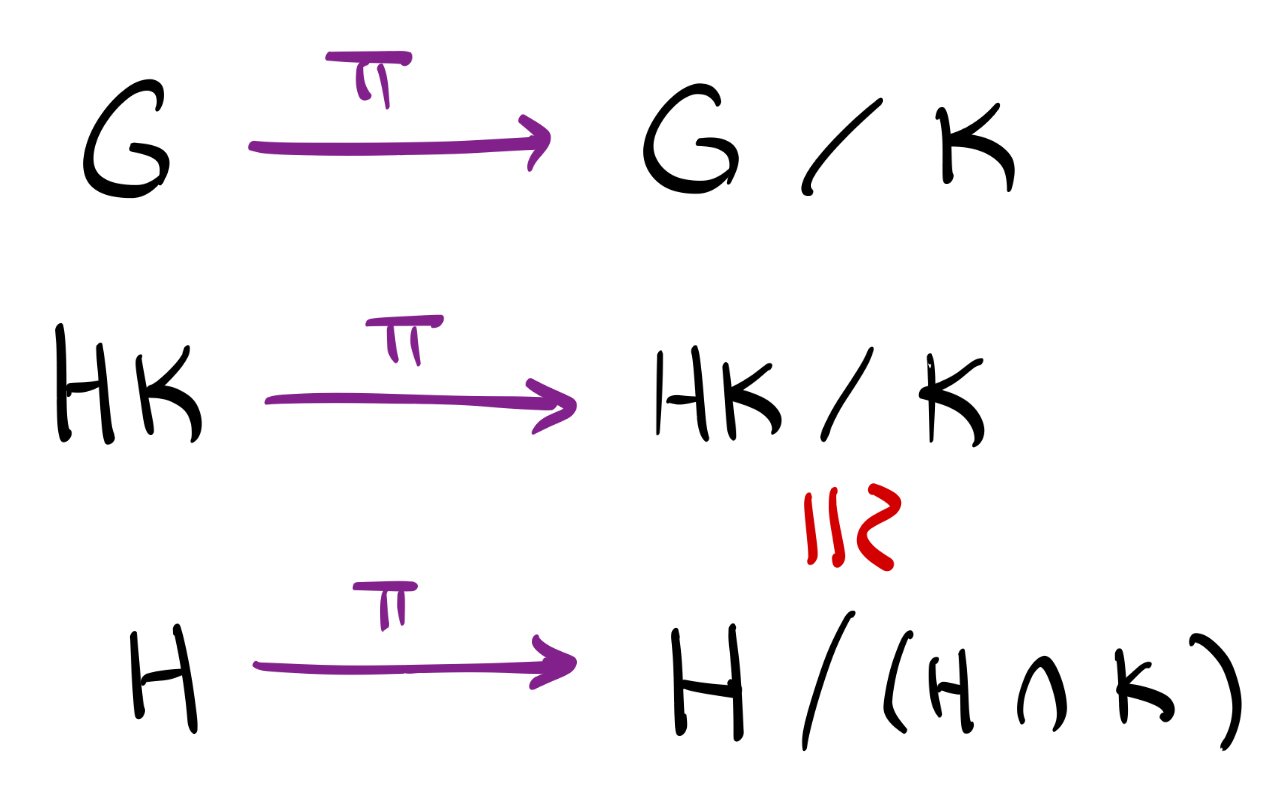
For the second point, we'll use the quotient map π:G→G/K. Then:
The First Isomorphism Theorem says HK/K≅π(HK).
Since K=kerπ, we have π(HK)=π(H).
Well, π(H) is itself the image of π∣H:H→G/K. But ker(π∣H)=H∩K, so π(H)≅H/(H∩K).
Stringing together all three parts of the above yields HK/K≅H/(H∩K), as desired. ■
Some comments on the Second Isomorphism Theorem:
(#1)
Sometimes the Second Isomorphism Theorem is called the Third Isomorphism Theorem.
(#2)
For an alternative proof of the first point, rephrase the first point more naturally like so:
If K⊴G, then the group generated by H and K is HK={hk∣h∈H,k∈K}.
Usually, the group generated by H and K looks like {h1k1h2k2⋯∣hi∈H,ki∈K}. However, when K⊴G, we have the property that for any h∈H and k∈K, there is some k′∈K such that kh=hk′.
So we may repeatedly use this property to shift all the ki's in the product h1k1h2k2… to the right.
(#3)
Nothing in G matters besides elements in HK. Thus, instead of mandating K⊴G, we could have gotten away with only mandating that hKh−1=K for all h∈H.
In other words, the clause “K⊴G” in the theorem statement could have been replaced with “H⊆N(K)”. Here, N(K) denotes the normalizer of K: the set N(K):={g∈G:gKg−1=K}.
§ The Diamond Lemma
Now for the second of the two lemmas.
Theorem. (Diamond Lemma) If H and K are distinct normal subgroups of G with G/H and G/K both simple, then
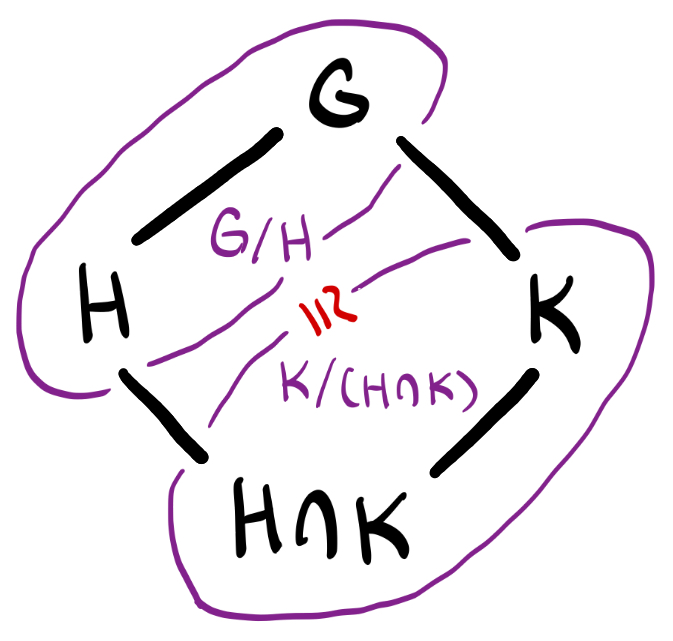
G/H≅K/(H∩K) and G/K≅H/(H∩K).
Proof: By symmetry, it suffices only to prove G/K≅H/(H∩K). Well, recall that the Second Isomorphism Theorem says H/(H∩K)≅HK/K. So it suffices to prove G/K≅HK/K.
Since H and K are normal subgroups of G, so is HK. Then HK⊴G implies (HK/K)⊴(G/K) as well. But G/K was assumed to be simple! Thus, either HK/K≅{1} or HK/K≅G/K.
The latter is what we want, so assume the former: HK/K≅{1}, or equivalently, H⊆K. This lets us talk about K/H; in particular, (K/H)⊴(G/H) holds. But we now have another problem: G/H was assumed to be simple!
Thus, either K/H={1} or K/H=G/H.
The former implies K=H, contradicting the assumption K=H in the theorem statement.
The latter implies K=G, contradicting the assumption that G/K was simple. (Trivial groups aren't simple!)
So we're done. ■
There's not much to say about the Diamond Lemma. The following image reveals the meaning behind its name:
§ Proof of The Jordan-Holder Theorem
We're now ready to prove the Jordan-Holder Theorem. Recall that we have a group G with two composition series:
G=A0⊇A1⊇⋯⊇Ar={1} and G=B0⊇B1⊇⋯⊇Bs={1}
We'd like to show these two series are equivalent; that is, their simple quotients {Ai/Ai+1} and {Bi/Bi+1} map bijectively with each other. Our approach is induction on r, with inductive hypothesis:
Inductive Hypothesis. If a group G′ has any composition series of length r−1, then all composition series of G′ are equivalent.
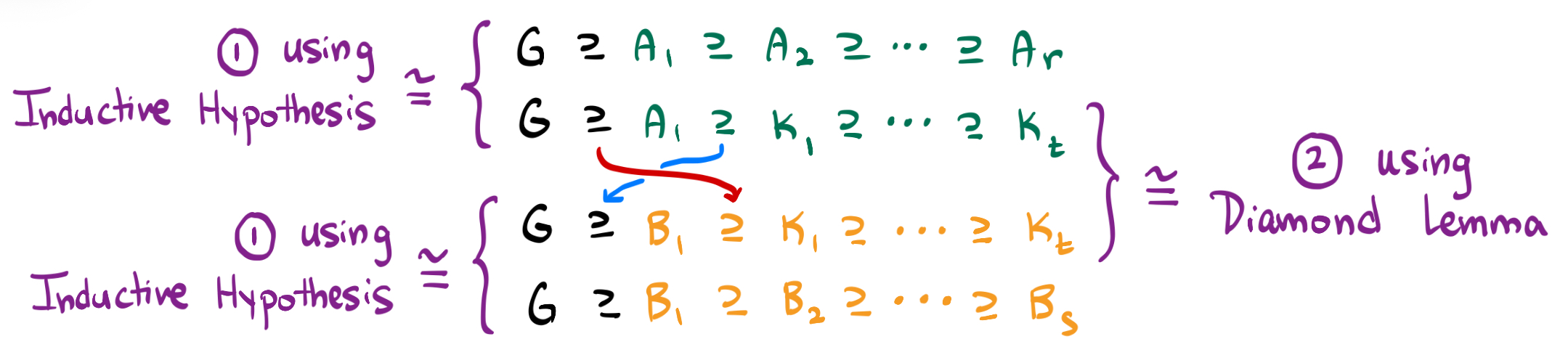
(Here we WLOG r≥s.) The entire rest of the proof is captured in the following chain of equivalences:
There are two steps to the proof: step 1 and step 2.
1
We may assume A1=B1; indeed, if A1=B1, then the inductive hypothesis would tell us A1⊇⋯⊇Ar and B1⊇⋯⊇Bs were equivalent, and we'd be done.
Now consider K1=A1∩B1, along with any composition series K1⊇⋯⊇Kt of K1.
Claim. The chain A1⊇K1⊇⋯⊇Kt is a valid composition series of A1.
Proof: It suffices to show A1/K1 is simple. This follows from the Diamond Lemma, which says A1/K1≅G/B1. And G/B1 is simple by definition. □
Thus, we have constructed two composition series of A1 (green in the original diagram):
A1⊇A2⊇⋯⊇Ar and A1⊇K1⊇⋯⊇Kt.
But the former of these two composition series has length r−1. So by the inductive hypothesis, these two composition series are equivalent, as desired.
2
This follows immediately from the Diamond Lemma, which says G/A1≅B1/K1, and G/B1≅A1/K1.