Gram-Schmidt, Sylvester's Criterion, The Spectral Theorem
§ Inner Product ⟺ Orthonormal Basis
Definition (Inner Product). An inner product is a symmetric and positive definite Hermitian / bilinear form.
Definition (Euclidean / Hermitian Space). We say that…
A Euclidean space is a finite-dimensional R-vector space with an inner product.
A Hermitian space is a finite-dimensional C-vector space with a Hermitian inner product.
Last time, we showed that all symmetric bilinear / Hermitian forms look like ⟨x,y⟩=x†My, where M is diagonal with entries 1, −1, or 0. In the particular case when ⟨∙,∙⟩ is positive definite, all diagonal entries have to be 1, so:
Theorem. (Orthonormal Basis) Every Euclidean or Hermitian space has an orthonormal basis; that is, a basis {bi} such that ⟨bi,bj⟩=1 whenever i=j and 0 otherwise.
In particular, the inner product of any Hermitian space might as well just be ⟨x,y⟩=x†y.
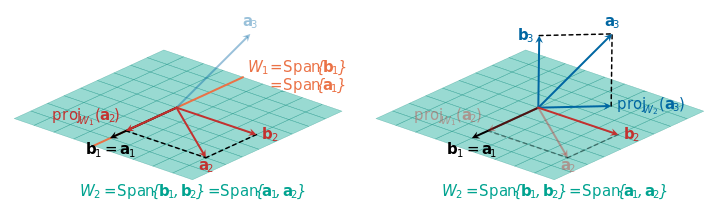
Example. (Gram-Schmidt Orthogonalization) Given a basis {bi}i=1n of a Euclidean or Hermitian space, how do we make it orthonormal?
Solution: Follow a procedure known as the Gram-Schmidt Process.
Begin by normalizing every basis element: bi↦∣bi∣bi. Now ∣bi∣=1 for all i.
Now for each index i=2,…,n, do the following:
Replace bi with bi−(∑j=1i−1⟨bj,bi⟩⋅bj).
Then normalize bi again via bi↦∣bi∣bi.
The point is that (∑j=1i−1⟨bj,bi⟩⋅bj) is the orthogonal projection of bi onto the span of {b1,…,bi−1}.
Subtracting the projection of bi from bi will yield a bi orthogonal to all of {b1,…,bi−1}, as desired. ■
Remark. (Reading Comprehension) Three questions:
Why was normalizing every {bi} necessary?
What goes wrong if the original {bi}i=1n isn't a basis?
What goes wrong if the space is not Hermitian?
§ Positive Definite Matrices and Sylvester's Criterion
Definition (Positive Definite). A matrix M∈Hermn(C) is positive definite if ⟨x,y⟩=x†My is positive definite.
Observe that if ⟨x,y⟩=x†My is positive definite, its signature must be (n,0,0). So any positive definite M must look like In after a change of basis by some B∈GLn(C). In other words…
Definition (Positive Definite). A matrix M∈Hermn(C) is positive definite if M=B†B for some B∈GLn(C).
Finally, here's one more equivalent definition for “positive definite”.
Theorem. (Sylvester's Criterion) A matrix A∈Hermn(C) is positive definite if and only if:
det(Aij∣1≤i,j≤k)>0 for all k∈{1,2,…,n}.
Note that Aij∣1≤i,j≤k just refers to the top-left k×k submatrix of A.
Proof: One direction is easy: if A is positive definite, then A=B†B for some B∈GLn(C), so:
det(A)=det(B†B)=det(B)det(B)=∣det(B)∣2>0 since detB=0.
Furthermore, the top-left k×k submatrices of A are restrictions of A to a subspace, so they are also positive definite, meaning their determinants are also positive, done.
Now for the other direction: assume det(Aij∣1≤i,j≤k)>0 for all k. To show A is positive definite, it's equivalent to find an orthonormal basis of Cn through which A is the identity.
We'll construct our basis in a manner similar to the Gram-Schmidt process.
Begin with the standard basis of normalized unit vectors (e1,…,en).
Adjust each of the e2,…,en to be orthogonal to e1 in the following manner.
Replace ei with ei−⟨e1,e1⟩⟨e1,ei⟩e1 for all i>1.
Normalize every ei again.
We now have ⟨ei,e1⟩=0 for all i>1. Thus, A must now have the following form:
A=A110⋮00♣⋮♣⋯⋯⋱⋯0♣⋮♣, where B=♣⋮♣⋯⋱⋯♣⋮♣ is an (n−1)×(n−1) submatrix.
The key now is the following claim, which follows from A11>0 and plain determinant computations:
Claim. The positivity of det(Aij∣1≤i,j≤k) for all k∈{1,2,…,n} translates directly into the positivity of det(Bij∣1≤i,j≤k) for all k∈{1,2,…,n−1}.
So we can recursively repeat this process on B, inducting downward. ■
Warning! Consider the following claim.
Claim. A matrix A∈Hermn(C) is positive semidefinite if and only if det(Aij∣1≤i,j≤k)≥0 for all k.
This claim is wrong! Take A=[000−1] for a counterexample.
§ Matrix Adjective Review: Hermitian, Unitary, and Normal
Definition (Adjoint). The conjugate transpose T† of a matrix T is also called the adjoint of T.
Definition (Hermitian, Unitary, Normal). We have the following adjectives for matrices T∈Cn×n.
A matrix T is Hermitian if ⟨x,Ty⟩=⟨Tx,y⟩. (Equivalently, if T=T†.)
(Why do we care?) Hermitian forms ⟨x,y⟩=x†My rely on M being Hermitian.
A matrix T is unitary if ⟨Tx,Ty⟩=⟨x,y⟩. (Equivalently, if TT†=In.)
(Why do we care?) Unitary matrices preserve the inner product, just like orthogonal matrices.
(Why do we care?) Just as reading off the columns of an orthogonal matrix yields an orthonormal basis, reading off the columns of a unitary matrix yields an orthonormal basis, too!
A matrix T is normal if ⟨Tx,Ty⟩=⟨T†x,T†y⟩. (Equivalently, if TT†=T†T.)
(Why do we care?) Normal matrices generalize Hermitian or unitary matrices. Notably, [6i007i] is normal yet neither Hermitian nor unitary.
Note that the equivalencies described above are not entirely trivial: check them for yourself!
§ The Spectral Theorem
We'll conclude lecture by proving the following (very strong!) theorem.
Theorem. (Spectral Theorem) Consider a Hermitian space V and a matrix T:V→V. Then the eigenvectors of T form an orthonormal basis of V if and only if T is normal.
Equivalently, T is normal if and only if T is diagonalizable via conjugation by a unitary matrix; that is,
For some U∈Un(C), we have T=U−1ΛU,where Λ=[λ1⋮0⋯⋱⋯0⋮λn] is a matrix of eigenvalues.
(Why must U be unitary? Recall the “why do we care” notes about unitary matrices…)
Note that the Spectral Theorem is stronger than our result from last lecture! Since Hermitian matrices are also normal, the Spectral Theorem says they must be diagonalizable. (Specifically by a unitary matrix, too!)
Proof: One direction is easy: suppose such a U exists. Since U is unitary, we have U†=U−1, so:
T=U†ΛU and T†=U†Λ†U.⟹TT†=U†ΛΛ†U=U†Λ†ΛU=T†T.⟹T is normal.
Now for the hard part: showing T is diagonalizable given T is normal. We'll need two lemmas.
Lemma 1. Suppose W⊆V such that TW⊆W. Then we also have T†W⊥⊆W⊥.
Proof: It's just a chain of implications.
u∈W⊥⟺⟹⟺⟨u,w⟩=0 for all w∈W⟨u,Tw⟩=0 for all w∈W⟨T†u,w⟩=0 for all w∈W⟺T†u∈W⊥.□
Our first lemma didn't actually need T to be normal! Our second lemma, on the other hand…
Lemma 2. Suppose T is normal with eigenvector v satisfying Tv=λv. Then T†v=λv.
Proof: Let's handle the λ=0 case first.
⟨T†v,T†v⟩=⟨Tv,Tv⟩=⟨0,0⟩=0.
But since ⟨∙,∙⟩ is positive definite, we must have T†v=0 as well.
In the λ=0 case, observe that T′:=T−λIn is normal. This reduces us to the λ=0 case, in that we know (T′)†v=0. This implies:
(T′)†v=0⟹(T†−λIn)v=0⟹T†v=λv.□
Now for the actual proof: induct on dimV. Pick some eigenvector v∈V, and consider W=Cv. Then:
Since W is an eigenspace of T, we have TW⊆W.
By Lemma 2, W is an eigenspace of T† as well, so we have T†W⊆W, too.
By Lemma 1, the previous two points imply TW⊥⊆W⊥ and T†W⊥⊆W⊥.
That final point means T∣W⊥ and T∣W⊥† are well-defined. In particular:
We have T∣W⊥ is normal, so by the inductive hypothesis, T∣W⊥ can be diagonalized by a unitary matrix.
We have W=Cv is one-dimensional, so T∣W is diagonalized to start with.
Since V=W⊕W⊥, combining the diagonalizations of T∣W⊥ and T∣W yields a diagonalization of T. And since W and W⊥ are perpendicular, this diagonalization has an orthonormal basis. ■
It turns out that the Spectral Theorem is a very powerful hammer, and there are a lot more nails to use it on than you'd expect. We'll leave the hammering of nails for next lecture.