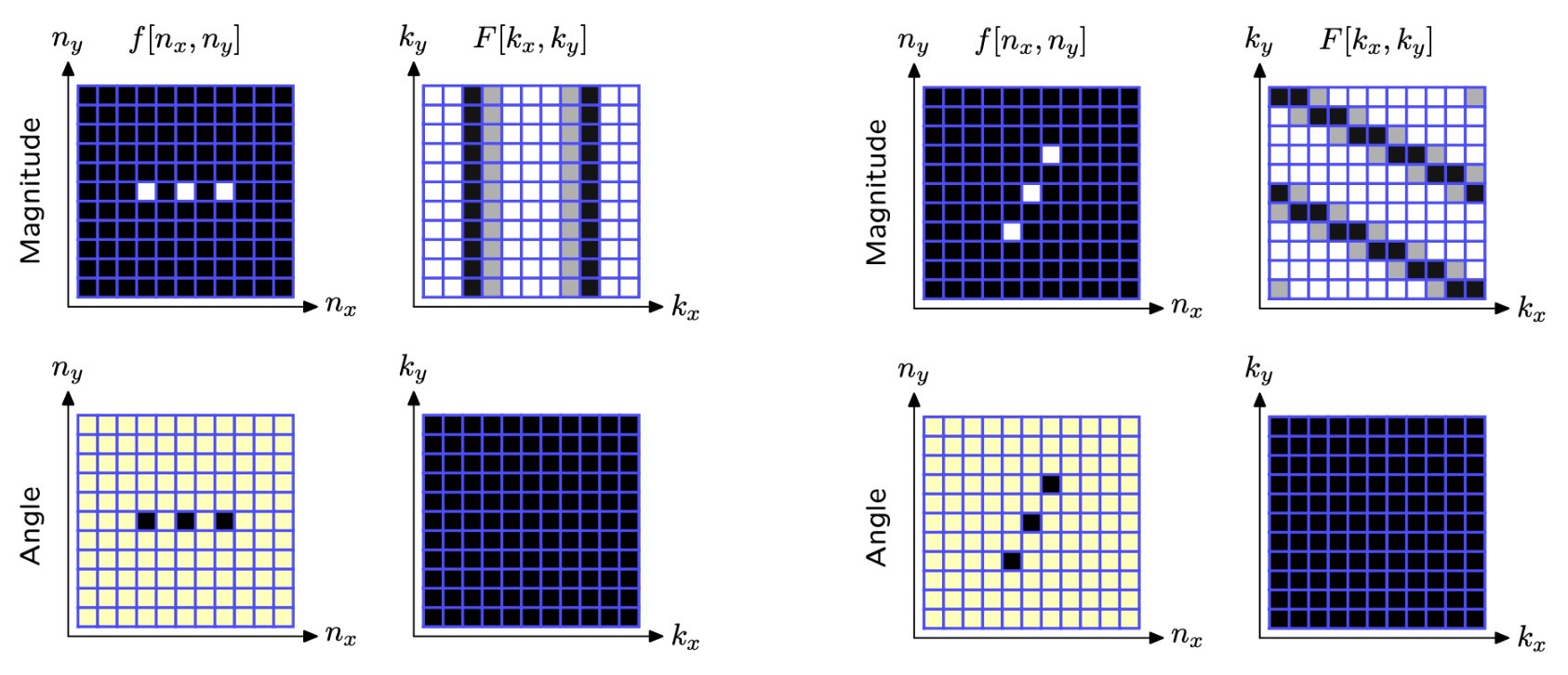
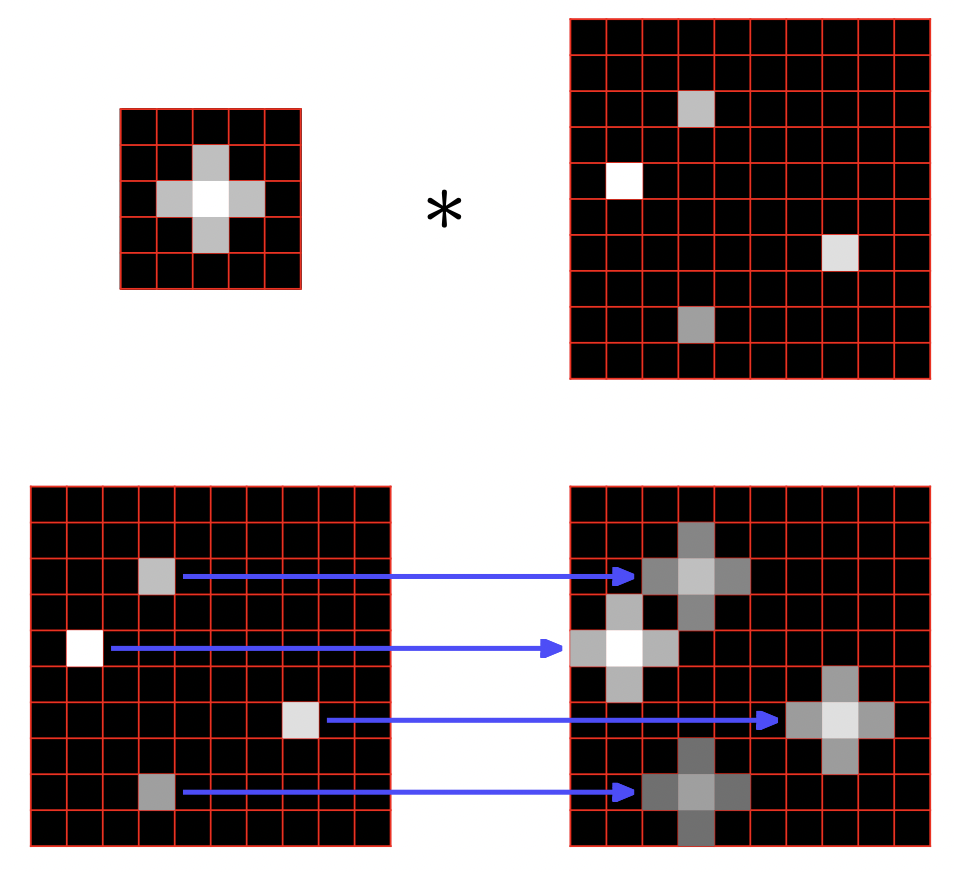
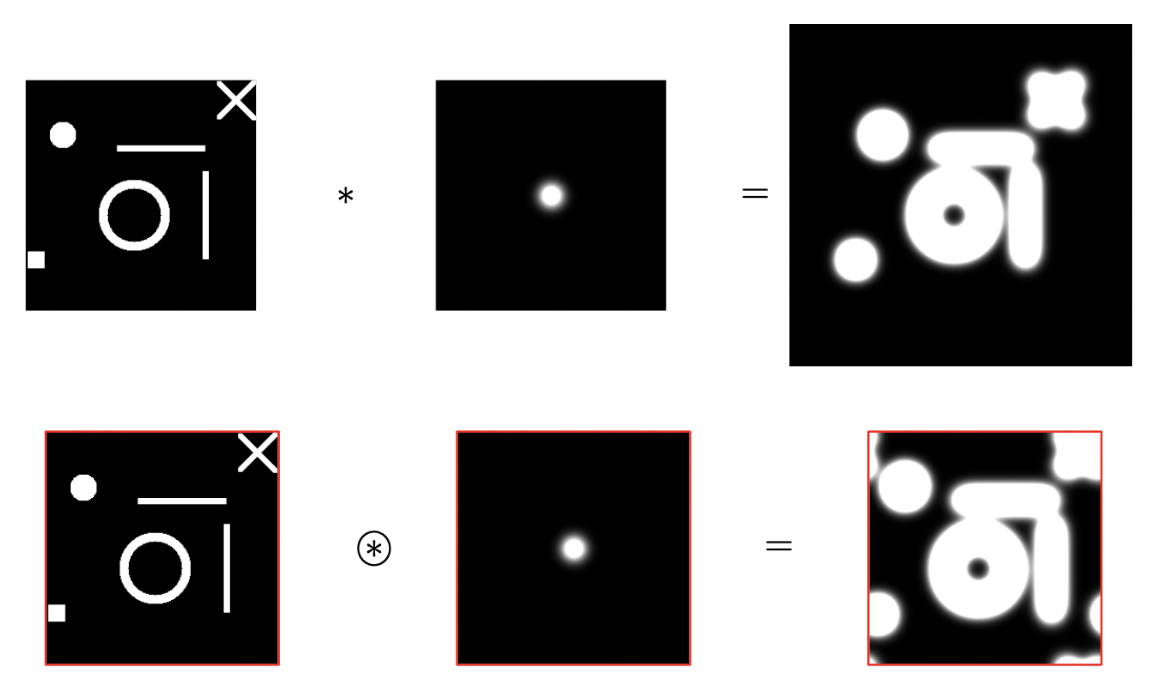
Below is a visual demonstration of the above theorem.
Remark. Check yourself: why does it make sense that the DFT of three dots arranged this way should look like a cosine wave?
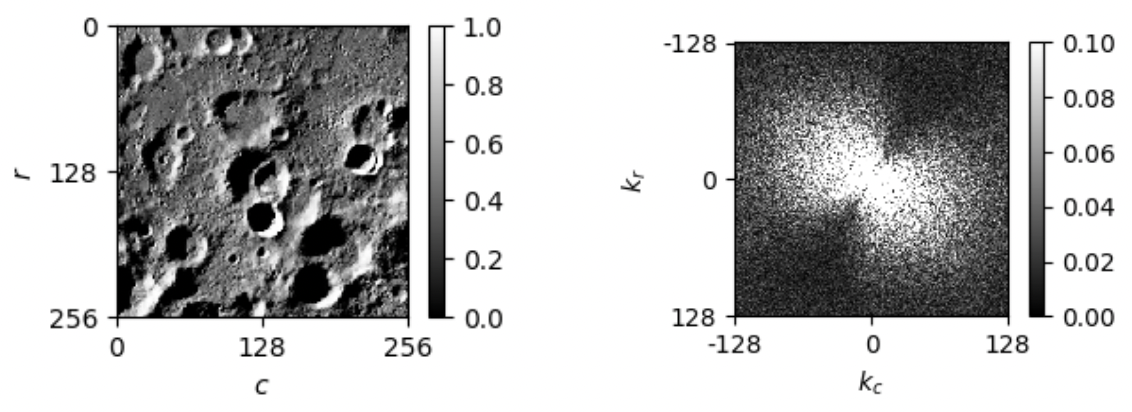
Below is the DFT of the moon. Notice how the DFT features strong signals along the west-northwest to east-southeast axis.
This should make sense—do you see the presence of north-northeast to south-southwest signals in the original image?
§ Lecture: Phase
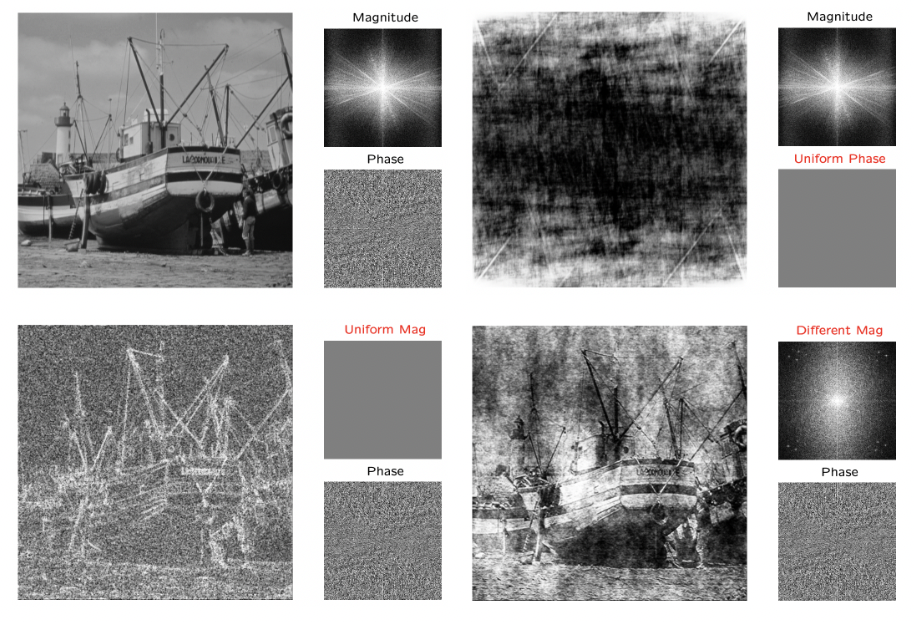
All of the discussion so far has concerned the magnitude of the DFT. What about the phase?
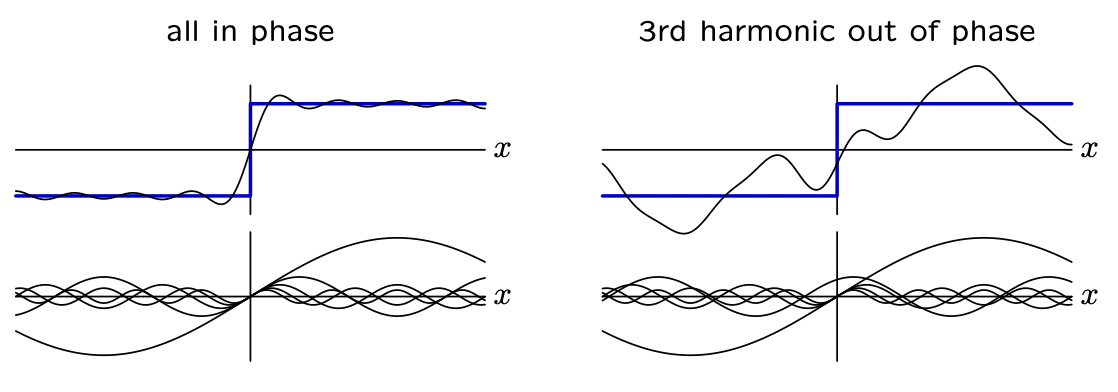
Evidently, phase is hugely important for visual perception—but strangely, not so much for auditory perception. Why is that?
The point is that visual perception cares a lot about edge detection, and even just a single out-of-phase harmonic can ruin that. In contrast, the ear cares mostly about frequencies, not about the relative phases of those frequencies.
§ Lecture and Recitation: Convolution and Filtering
Convolution in 2D works just as you'd expect.
There's conventional convolution and circular convolution, too.
And of course, convolution and the DFT behave nicely together, too.
Theorem. (Circular Convolution = Multiplication) Suppose the DFTs of f[nx,ny] and g[nx,ny] are F[kx,ky] and G[kx,ky], respectively. Then the DFT of (f⊛g)[nx,ny] is NxNy⋅F[kx,ky]⋅G[kx,ky], and the DFT of (f⋅g)[nx,ny] is (F⊛G)[kx,ky].
Proof: Same idea as in the 1D case from Lecture 13, just with multivariate polynomials this time. ■
Problem. Given that H[kr,kc]=(−1)kr+kc, determine how (f⊛h)[r,c] relates to f[r,c].
Solution: Note that H is separable via H[kr,kc]=(−1)kr⋅(−1)kc. Taking H1[kr]:=(−1)kr and H2[kc]:=(−1)kc, we have (assuming Nr and Nc are even):
h1[r]:=DFT−1(H1[kr])=Nr⋅δ[r−2Nr] and h2[c]:=DFT−1(H2[kc])=Nc⋅δ[c−2Nc]
Therefore, the inverse DFT of H[kr,kc] is the product of the two expressions above.