MIT 6.300 — Lecture 5
DT Fourier Series
§ Lecture: DT Fourier Series
Recall that for CT signals, Fourier series are infinite sums.
However, for DT signals, the period is always an integer. And when is an integer, something special happens.
Terms spaced apart in the infinite sum are “like terms”—so our infinite series collapses down to a finite series!
Remark. The above logic is unique to DT signals because of the final step , which only holds assuming .
Theorem. (DT Fourier Series) For any DT signal with period and fundamental frequency , its Fourier series is:
Proof: The same argument as earlier. The point is that equals if and otherwise.
Just as before, we can also consider transformations of DT signals; the logic is exactly the same.
Theorem. (Transforming DT Signals) Let denote the Fourier series coefficients for . Assume period .
Linearity: If , then .
Time Shift: If , then .
Time Reversal: If , then .
Conjugate Symmetry: If is real-valued, then and are conjugates.
Note that is shorthand for (just like with Python arrays).
§ Lecture: Pitch Perception
Recall that when (say) a piano plays A440 Hz, there are more frequencies present than just plain 440 Hz. In other words, many of the coefficients of a piano's Fourier series are nonzero!
But the existence of, say, 880 Hz and 1320 Hz frequencies doesn't make us hear the piano's pitch as anything other than 440 Hz…
Question. To what extent is perceived pitch influenced by upper harmonic frequencies?
In the setup below, we pass a jet of air through a spinning disk with holes. By changing the hole placement (but keeping the disk speed constant), we can produce different DT signals with the same fundamental frequency.
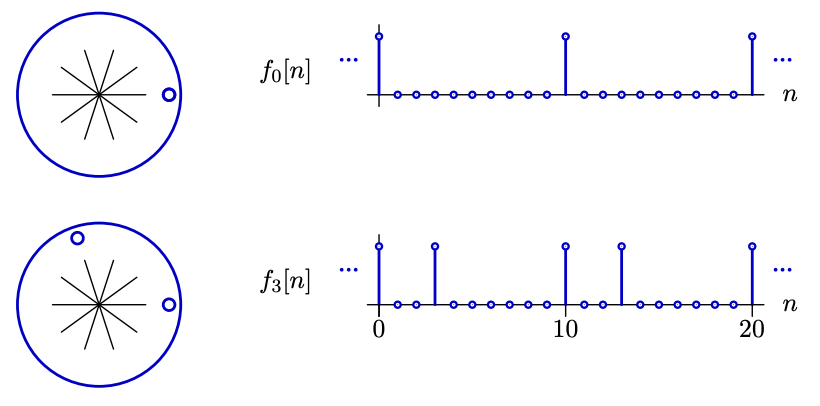
By computing Fourier coefficients for the DT signal , we can find the strength of the “intended” pitch by reading off .
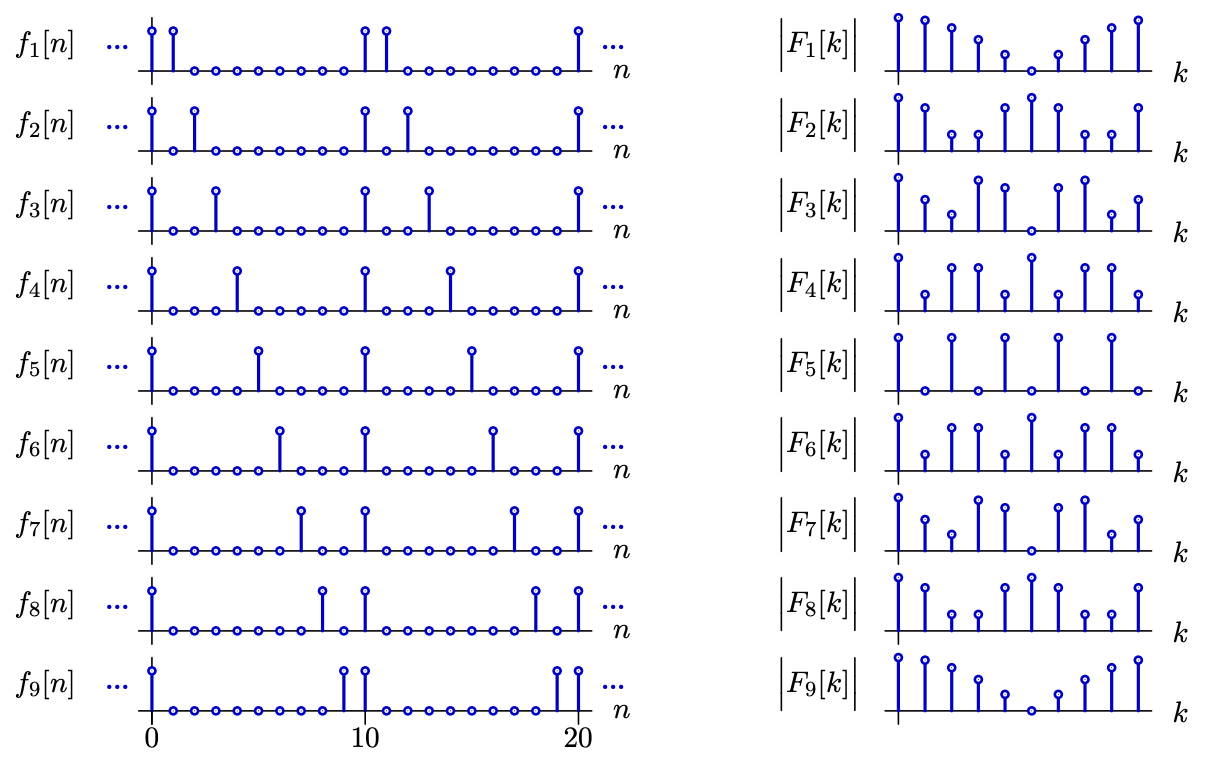
Mathematically, the intended pitch appears to be weakest around . In particular, when the two holes are precisely opposite each other, the DT signal exactly matches , and the perceived pitch ends up being twice the intended pitch.
The surprising part, however, is that the perceived pitch of and still matches the intended pitch. Only in the exact case of is the perceived pitch wrong.
Let's say we alter the signals by setting only the coefficient , thereby removing the fundamental frequency and leaving behind only the upper harmonics. Even then, the perceived pitch still matches the intended pitch!
§ Recitation: Computing DT Fourier Series
Problem. Determine the Fourier coefficients for .
Solution: The only novelty is that we must first compute the period , and from there determine that . Then:
So the coefficients are , , and all other coefficients are zero.